

close
Choose Your Site
Global
Social Media


Author: Site Editor Publish Time: 2026-02-12 Origin: Site
The debate between organic and synthetic fertilizers is one of the oldest and most persistent in agriculture. It often feels like a philosophical divide. Proponents of organics swear by the slow, steady rhythm of nature, while fans of synthetics rely on the precision and speed of science.
But here is the truth that often gets lost in the noise: plants cannot tell the difference between a nitrate molecule derived from compost and one synthesized in a lab. To a plant root, nitrogen is nitrogen. The real difference lies in how those nutrients are delivered, how they affect the soil microbiome, and what they do to your garden’s long-term future.
In this guide, we will break down exactly how these two types of fertilizers work, compare them side-by-side, and give you a practical step-by-step framework to decide which one deserves a spot in your shed.
Before we can decide which is “better,” we need to understand what we are actually putting in the ground. The labels can be confusing, but the distinction comes down to the source of the materials and how they are processed.
Organic fertilizers are derived from living (or once-living) material. They are made from plant, animal, or mineral-based sources. Crucially, these fertilizers are not “ready to eat” for plants immediately upon application. They require the help of soil microorganisms—bacteria and fungi—to break them down into a form that plant roots can absorb. This process is called mineralization.
Because they rely on natural breakdown, organic fertilizers are often described as “soil food” rather than just plant food.
Common examples you will recognize:
Compost and Manure: The most common forms, offering a broad mix of nutrients.
Bone Meal and Blood Meal: By-products of the meat industry, high in phosphorus and nitrogen, respectively.
Guano: Bat or seabird droppings, known for high nitrogen content.
Phosphate Rock: A mined mineral source of phosphorus.
Fish Emulsion: A liquid fertilizer made from processed fish by-products.
Synthetic fertilizers, often called inorganic or chemical fertilizers, are man-made compounds. They are manufactured through chemical processes (like the Haber-Bosch process for nitrogen) to create specific, concentrated formulas.
Unlike organics, synthetics are typically water-soluble. This means the nutrients are available to the plant immediately after watering, without needing soil microbes to break them down first.
Common examples you will recognize:
Urea: A highly concentrated source of nitrogen.
Ammonium Nitrate: A quick-release nitrogen source often used in agriculture.
MAP (Monoammonium Phosphate): A major source of phosphorus and nitrogen.
MKP (Monopotassium Phosphate): A soluble salt used for potassium and phosphorus.
“Blue” Crystals: The generic, water-soluble plant foods found in most garden centers.
To help you visualize the trade-offs, here is a breakdown of the advantages and drawbacks of each approach.
Improves fertility and soil health: Adds carbon and feeds the microbiome.
Better water retention: Organic matter acts like a sponge, helping soil absorb and hold rainfall.
Gradual nutrient release: Reduces the risk of “fertilizer burn” and over-fertilization.
Sustainable: Often uses waste products (manure, compost) rather than extracting new resources.
Hard to apply precisely: Variable nutrient content makes math difficult.
Slower outcomes: You won’t see a change overnight. It requires patience.
Weather dependent: Microbes go dormant in cold weather, meaning organic fertilizers are less effective in early spring or late fall.
Smell and Bulk: Handling manure and fish emulsion can be unpleasant and heavy work.
Precise nutrient control: You know exactly what you are giving your plants.
Fast results: Can turn a yellow lawn green in a matter of days.
Easy application: Available in easy-to-spread granules, water-soluble powders, and spikes.
Cost-effective: Generally cheaper per pound of nutrient than organic options.
Higher burn risk: easy to accidentally kill plants if you misread the label.
Short-lived effect: The “sugar rush” of growth often crashes, requiring frequent re-application.
Soil degradation: Does nothing to prevent soil compaction or erosion.
Pollution risk: High potential for runoff into waterways.
If plants chemically absorb the same nutrients from both sources, why does the choice matter? The answer lies in the delivery system. The best way to visualize this is to look at how they “feed” the ecosystem of your garden.
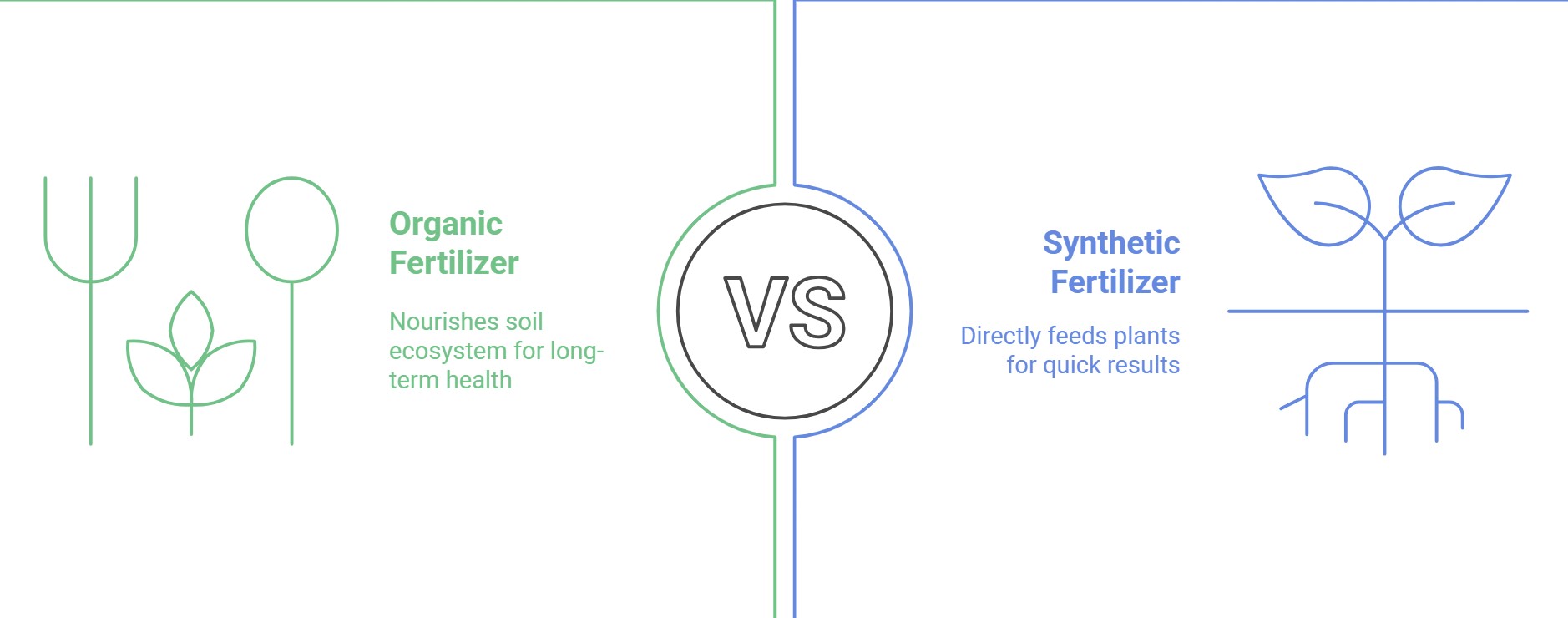
This adage sums up the fundamental difference.
When you apply organic fertilizer, you are essentially feeding the soil livestock—the billions of microbes, earthworms, and fungi living beneath your feet. As these organisms digest the organic matter, they slowly release nutrients as waste products. This process improves the soil structure, increases aeration, and boosts the soil’s ability to hold water. You are building a self-sustaining system.
When you apply synthetic fertilizer, you are bypassing the soil ecosystem to deliver a direct injection of nutrients to the plant. It is like an IV drip for your crops. It is highly effective and fast, but it does little to nothing to improve the soil texture or life. If you rely solely on synthetics for years, your soil can turn into a sterile growing medium that acts merely as a structural anchor for roots, rather than a living partner in growth.
The “feed the soil” vs. “feed the plant” distinction isn’t just academic; it changes what you see in your garden:
Growth Speed: Synthetics promote rapid, visible growth spurts (often within days). Organics promote steady, sustained growth over weeks or months.
Root Development: Because organic nutrients aren’t spoon-fed, roots often grow deeper and stronger as they forage for nutrients in the soil structure.
Watering Needs: Soils treated with organic matter hold water like a sponge, reducing the need for irrigation. Synthetic-fed soils may dry out faster if organic matter isn’t replenished.
Let’s look at the technical differences that affect your daily gardening routine.
| Comparison Factor | Synthetic Fertilizer | Organic Fertilizer |
|---|---|---|
| Nutrient concentration | Very high — small amount delivers large nutrient dose | Low to moderate — larger volume needed for same N-P-K |
| Consistency & precision | Highly precise — labeled nutrients are exact and predictable | Variable — nutrient content depends on source and batch |
| Nutrient release speed | Fast / immediate — nutrients dissolve and are quickly absorbed | Slow / gradual — microbes release nutrients over time |
| Risk of fertilizer burn | High if over-applied — salts can damage roots and leaves | Low — generally safe and forgiving (except fresh manure) |
| Impact on soil health | Neutral to negative — feeds plants but not soil life | Strongly positive — improves structure, microbes, organic matter |
| Environmental impact | Higher risk — leaching, runoff, algae blooms, higher carbon footprint | Lower risk — nutrients stay in soil longer when managed correctly |
Synthetic: These are highly concentrated. A 50-pound bag of synthetic fertilizer packs a massive punch. For example, a “Triple 10” (10-10-10) synthetic fertilizer has significantly more immediately available nitrogen by weight than compost. This means you handle fewer bags and apply smaller physical amounts.
Organic: These generally have lower N-P-K (Nitrogen-Phosphorus-Potassium) numbers. To get the same amount of nitrogen found in a handful of synthetic granules, you might need shovelfuls of compost. This bulk is actually a benefit for soil structure, but it requires more physical labor to apply.
Synthetic: The manufacturing process is exact. If the bag says 10% nitrogen, it contains exactly 10% nitrogen. This makes it incredibly easy to calculate precise dosing for specific crops or lawn deficiencies.
Organic: Nature is variable. One batch of manure might be nutrient-dense, while the next is weaker. It is much harder to “dose” organic fertilizer precisely, which can be frustrating for commercial growers who need exact yields.
Synthetic: Fast. Once dissolved in water, the plant takes it up. This allows for rapid correction of deficiencies (like yellowing leaves). However, because it releases so fast, much of it can wash away (leach) before the plant grabs it if you over-water or it rains heavily.
Organic: Slow. Microbes work at their own pace, which is often dictated by warmth and moisture. This “slow-release” mechanism naturally prevents nutrients from washing away, keeping them in the soil until the plant needs them.
Synthetic: High risk. Because they are salts, synthetic fertilizers can draw moisture out of plant roots if applied too heavily. This results in “fertilizer burn,” where leaves turn brown and crispy overnight.
Organic: Low risk. It is very difficult to burn plants with most organic fertilizers (with the exception of fresh, non-composted manure, which is high in ammonia). They are generally gentle and forgiving.
Synthetic: Neutral to Negative. While they don’t inherently poison soil, they don’t improve it. Over time, the salts can build up, and the lack of organic carbon can starve beneficial microbes, damaging soil structure.
Organic: Positive. This is the superpower of organics. They increase organic matter, improve tilth (crumbly texture), and support a diverse food web underground.
Synthetic: Higher risk. Because they are soluble, excess synthetic nitrates and phosphates easily leach into groundwater or run off into local waterways, causing algae blooms and ecological damage. Manufacturing them also has a significant carbon footprint.
Organic: Lower risk. Because nutrients are locked in organic matter until microbes release them, they stay put. However, improper management of animal waste (like manure runoff) can still pose environmental issues.
The best choice isn’t always A or B—it depends on your specific situation. Use this four-step guide to determine what your garden needs right now.
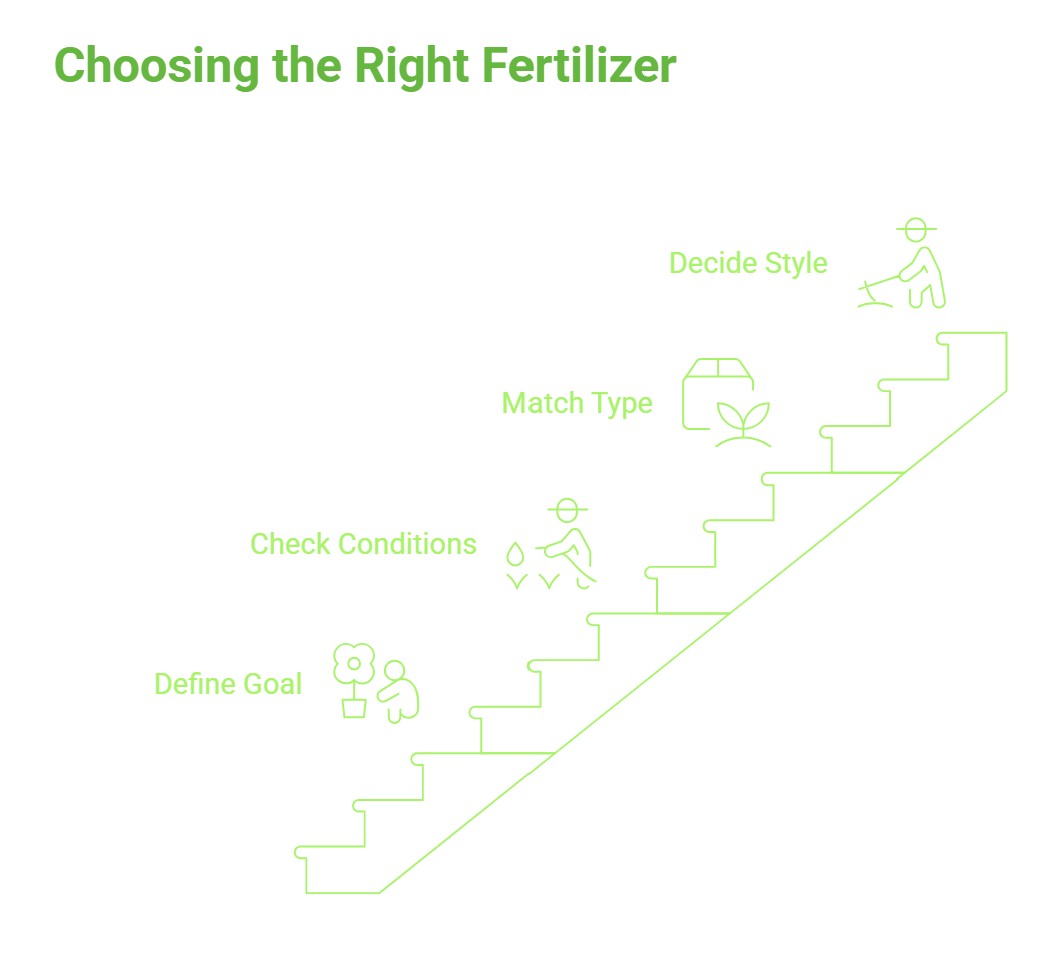
Are you in emergency mode, or maintenance mode?
“I need quick green-up / correction”: If your hanging baskets are yellowing or your tomato plants look stunted mid-season, synthetic fertilizer is the ambulance. It provides immediate relief.
“I want healthier soil and long-term stability”: If you are preparing a garden bed for next year or want a lawn that survives drought better, organic is the builder.
Soil Biology: If your soil is dead (dry, dusty, no worms), dumping organic fertilizer on top might not work fast enough because the microbes aren’t there to process it. You may need to incorporate compost first.
Temperature: If it is early spring and the soil is cold (below 50°F/10°C), organic fertilizers won’t release nutrients well. A light starter application of synthetic fertilizer can help plants wake up until the soil warms and the organics kick in.
Weather: If heavy rain is in the forecast, avoid synthetic fertilizers—they will wash away before they work.
Vegetable Gardens: A mix is often best. Use heavy organic compost to prep the beds, and perhaps a gentle organic feed during the season. Growing food in chemical-heavy soil often defeats the purpose of home gardening for many.
Lawns: If you want a “golf course” look, synthetics offer that precise, neon green. However, organic lawn care (using corn gluten meal or compost top-dressing) creates a lawn that is more resilient to foot traffic and drought over time, even if it isn’t as artificially dark green.
Container Plants: Pots have no natural ecosystem. They need frequent feeding because nutrients wash out the bottom. Synthetics (especially controlled-release pellets) are often more practical here, though liquid organic feeds work well too.
The “Set and Forget” Method: If you hate fertilizing, use organic or slow-release synthetic granules.
The “Control Freak” Method: If you love tending to plants weekly, using water-soluble synthetics allows you to micro-manage their growth.
Yes! In fact, this is often the winning strategy for smart gardeners. You can treat the soil with compost and organic matter to build structure and health (the “marathon” approach) while using small, targeted amounts of synthetic fertilizer during peak growth spurts or to correct deficiencies (the “sprint” approach). They are not mutually exclusive.
Yes. While it is harder to burn plants with organics, “too much of a good thing” still applies. Excessive manure can lead to phosphorus buildup in the soil, which blocks the uptake of other nutrients. Fresh manure can also be high in ammonia and pathogens. Always compost manure before applying it, and follow recommended rates.
Typically, no. Synthetics usually win the speed race because the nutrients are instantly available. Organic fertilizer promotes steady growth. Think of synthetics as an energy drink and organics as a balanced meal. The energy drink makes you run faster for an hour, but the meal keeps you going all day.
Fall fertilization is about root strength, not top growth. As the air cools, top growth slows, but roots continue to grow in the warm soil.
Organic: Excellent for fall. Apply compost or organic meals now to give them time to break down over winter, ensuring nutrients are ready for the spring wake-up.
Synthetic: Be careful. Applying high-nitrogen synthetic fertilizer in the fall can force new, tender green growth that will be killed by the first frost, damaging the plant. If using synthetics, choose a “Winterizer” formula with lower nitrogen and higher potassium for root health.
If you have been heavy-handed with the spreader, watch for these signs:
Fertilizer Burn: Leaf tips turn brown and crispy (“scorched”).
Wilting: Plants droop even when the soil is wet (because salts have damaged the roots’ ability to drink).
Salt Crust: A white, crusty layer appearing on the soil surface.
excessive foliage with no fruit:** Too much nitrogen often results in giant, bushy tomato plants that produce zero tomatoes.
The “Organic vs Synthetic” war doesn’t have to be a war at all. It is simply a choice between two different tools in your gardening belt. Choose Synthetic when you need speed, precision, and a quick fix for hungry plants. It is the sprinter of the fertilizer world—fast, powerful, but short-lived and risky if misused. Choose Organic when you want to build a legacy in your soil. It is the marathon runner—steady, resilient, and focused on the long-term health of the entire ecosystem.For the best garden, focus on building rich, organic soil first. A plant growing in healthy, living soil will rarely need the “ambulance” of synthetic chemicals. But don’t be afraid to use them if your plants need a helping hand.
Use our step-by-step guide to choose the best option-and partner with Rizhao Organic for reliable, export-ready organic fertilizers. Backed by strong R&D and global supply experience, we offer organic nitrogen, phosphorus, potassium, and organic NPK solutions to support healthier soil and consistent crop performance.


